
STEM and emerging technologies are everywhere—even in sports. Driven by my recently developed love for volleyball and my goal to improve my gameplay, I decided to create a post about where I am making those connections.
For both humans and technology, data, learning, and repetition are crucial to mastering any new skill. With that understanding, I decided to level up my volleyball knowledge and skills by digging into some research and making connections to what I know. What I discovered is that volleyball isn’t just a sport—it’s a laboratory for science, math, and innovation. From the court’s engineering to the biomechanics of a spike, the game seamlessly integrates STEM concepts. Now, with artificial intelligence stepping in, volleyball has become even more fascinating. AI tools like performance trackers, predictive analytics, and smart volleyballs are changing how athletes train and compete. This new layer of technology makes learning more precise, training more efficient, and gameplay more strategic.
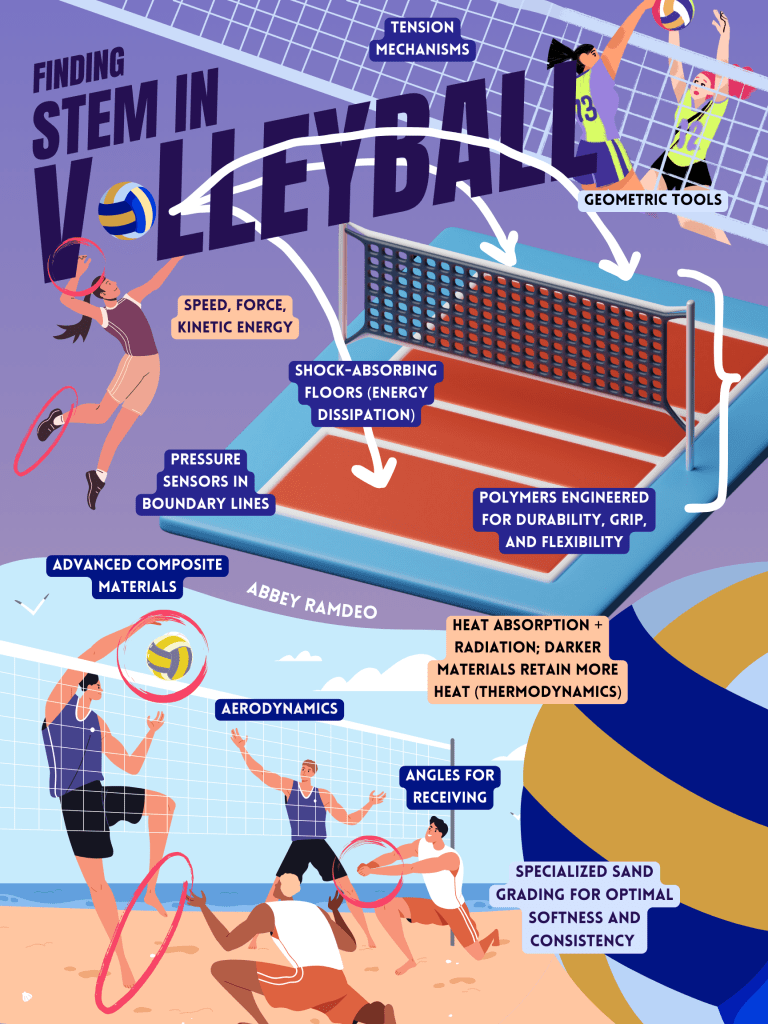
The Volleyball Court: A STEM Masterpiece
Volleyball courts may look simple, but they’re engineered for peak performance and safety.
Physics in Action:
- Shock-Absorbing Floors: Indoor courts feature engineered wood or synthetic materials that reduce the impact on players’ joints. These surfaces are designed using principles of energy dissipation to keep players safe.
- Friction and Grip: The interaction between shoes and the court’s surface relies on the science of friction, allowing players to stop, pivot, and dive without slipping.
Geometry and Design:
- The court is a rectangle with precise dimensions. The area (ℓ × w) ensures regulation play, while boundary lines are marked using geometric tools to ensure perfect symmetry.
- For outdoor courts, sand is graded for uniform particle size, optimizing softness and consistency for players diving to make those game-saving plays.
Environmental Science:
- Outdoor beach volleyball courts are carefully designed to prevent erosion. UV-stabilized materials ensure the longevity of nets and sand under intense sunlight.
Sustainable Engineering:
- Modern courts increasingly incorporate recycled materials and solar-powered facilities, demonstrating how sustainability and sports go hand in hand.
The Technology Behind the Game
Advancements in engineering and technology are revolutionizing volleyball, offering players and coaches new tools to improve performance.
Smart Equipment:
- Smart Volleyballs: Embedded sensors track spin, speed, and trajectory, giving real-time feedback to players and coaches.
- Wearable Motion Sensors: Devices like wristbands and smart shoes monitor player movements, heart rate, and even jump height during training.
Court Innovations:
- LED-Illuminated Lines: Some courts now feature boundary lines that light up for better visibility, enhancing gameplay during night matches.
- Hawk-Eye Technology: This system tracks the ball’s trajectory with incredible precision, making line-call decisions instant and accurate.
Robotic Training Aids:
- Robots are now used to simulate serves, spikes, and even blocking, helping players train against high-speed, unpredictable scenarios.
The Math and Science of Play
Volleyball is a live demonstration of math and physics principles.
Ball Trajectory:
- The arc of a spike or serve follows projectile motion. Players adjust their angles and force to achieve the perfect trajectory, often using data-driven insights.
Biomechanics:
- Jumping, diving, and spiking involve complex movements where players maximize torque and minimize energy loss. Biomechanical analysis helps players refine these motions.
Statistics and Probability:
- Heatmaps of player movements and ball placements provide insights into strategies. Coaches use statistical models to predict opponents’ moves and optimize team formations.
Artificial Intelligence in Volleyball
AI is ushering in a new era for volleyball, enhancing training, analysis, and even fan engagement.
AI-Powered Performance Analysis:
- AI systems analyze video footage to track player movements, ball trajectory, and game patterns. These insights help coaches develop targeted strategies and identify areas for improvement.
Virtual Coaching Assistants:
- AI platforms act as virtual coaches, offering personalized training plans based on a player’s performance data. For example, AI can recommend drills to improve a hitter’s spike angles or a setter’s accuracy.
Fan Experience:
- AI-driven cameras enhance live broadcasts by automatically tracking the action and providing real-time statistics for fans.
Predictive Analytics:
- AI algorithms predict match outcomes by analyzing historical data, weather conditions, and even players’ mental and physical states.
💡 How I’m using AI in this sport: Obviously, as a non-professional player, I don’t have access to many advanced tools, but I’ve figured out that you can use ChatGPT to upload photos and digitally analyze the image to approximate angles using geometry. This simple yet powerful approach can transform how recreational players like me improve their game. By analyzing the angles of my arm during a spike or the trajectory of the ball on a serve, I get clear, actionable feedback on my technique. For instance, I’ve discovered adjustments to my arm extension and wrist snap timing that make my hits more accurate and powerful.
What’s even better is that this kind of analysis helps track progress over time. It’s a data-driven way to refine form, reduce inefficiencies, and practice with purpose. Whether you’re trying to hit sharper angles to avoid blockers or just serve more consistently, this DIY use of AI makes it easier to improve your game without needing high-end training tools. It’s all about playing smarter, even at a recreational level.
💬 How did I do it?

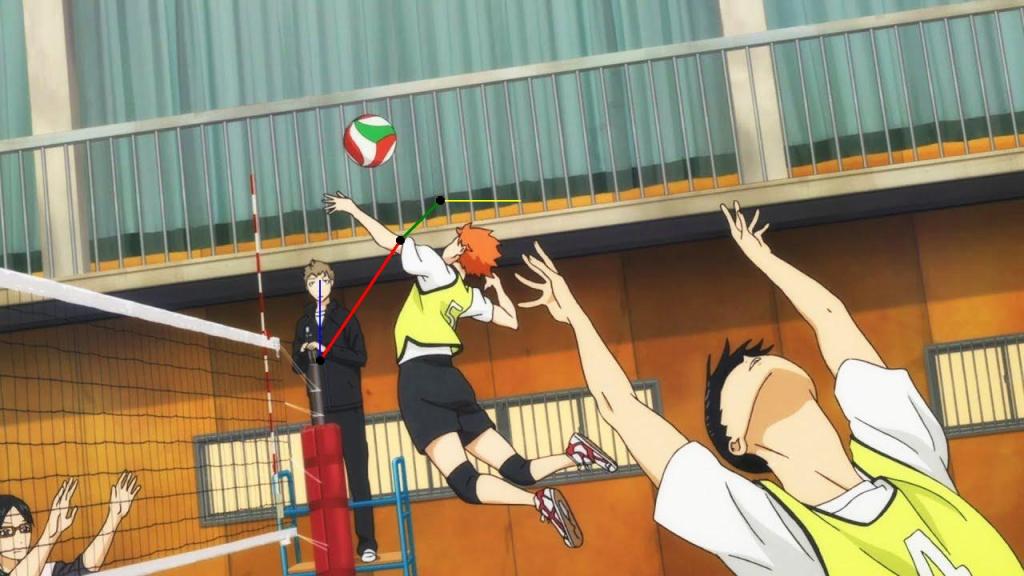
- Upload an image to ChatGPT and ask it to approximate the angle of the player’s arm and the ball’s trajectory in the image. This is a still from one of my favourite animes, “Haikyu!!”.
- To analyze this image and approximate the angles, ChatGPT will first process the visual input using geometry principles to provide an estimated angle of the player’s arm and the ball’s trajectory.
- Player’s Arm (Spiking Arm): The angle of the spiking arm can be estimated by measuring the tilt of the arm relative to the vertical axis.
- Ball’s Trajectory: The trajectory can be inferred by connecting the ball’s current position to where it would align with the player’s intended spike motion.
- It may ask for follow-up questions, such as sharing approximate locations of the ball and the arm joints (shoulder, elbow, wrist) to calculate the angles. If that’s not possible, you can prompt it to find out on its own. ChatGPT will use the image to estimate the angles based on key points.
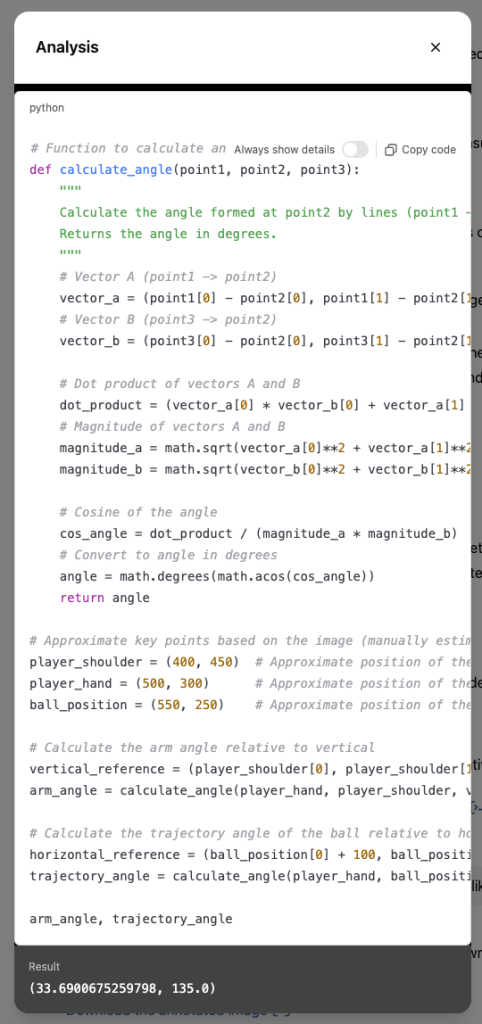
- ChatGPT will share the final results. You can prompt it to show you a visual. You can also find the code used to calculate the angles between two lines (see photos below)
- Player’s Arm Angle (relative to vertical): ~33.7° – This is the angle at which the player’s spiking arm is extended from the vertical line passing through the shoulder.
- Ball’s Trajectory Angle (relative to horizontal): ~135° – This represents the steep upward trajectory of the ball relative to the horizontal plane.
- As with anything generated by AI, it is critical to review the result and test it for accuracy and ask questions. Did it even correctly generate information on the angle I’m looking for? How can I validate it? Apps like Protractor, Angle Meter, or Coach’s Eye allow you to measure angles directly on video frames, but another angle (haha, see what I did there?) is to use a printed screenshot and a physical protractor to measure the angles manually. For this post, I’ll just be sharing what I’ve found and will check for accuracy when I begin my training.
💬 How does it improve game play?
After asking ChatGPT, here’s what I found:
- Arm Angle (Spiking Arm):
- Technique Consistency: Repeating this angle can improve muscle memory, making your spike more reliable during fast-paced gameplay.
- Power and Control: A well-calculated arm angle ensures maximum force generation during the spike. An angle like ~30-35° relative to vertical (as measured here) often indicates good preparation to contact the ball at its highest point.
- Reach: Knowing this angle helps you maximize reach and adjust your body positioning to spike over blockers effectively.
- Higher Arm Angle (~45°): Generates more height on the ball for spikes over taller blockers.
- Ball Trajectory:
- Placement: A trajectory angle of ~135° shows a steep downward spike aimed at the opposing court. This is often ideal for scoring, as it’s harder for opponents to defend.
- Adjustments for Defense: Understanding the ball’s path lets you predict whether the trajectory will hit the court or be defended, helping you fine-tune your wrist action and follow-through.
- Lower Ball Trajectory (~120°): Used for faster attacks or when aiming for gaps in the defense.
It’s fascinating to see how AI, like ChatGPT, can provide insights into something as dynamic as volleyball gameplay. These angle calculations offer a starting point, but the real magic happens on the court. Volleyball is a game of constant adjustment, and while these approximations are helpful, they’ll need to be validated and refined through trial and error in real-world scenarios.
I’m excited to try this out on myself during my next practice session and see how these insights can enhance my serves, spikes, and sets technique.
Final Thoughts
Volleyball isn’t just a thrilling sport of spikes, serves, and saves; it’s also a playground for science, math, and cutting-edge technology. So the next time you see a player spike the ball or dive for a save, know that there’s a lot more at play—science, math, and technology working in harmony to bring the game to life.
How do you think emerging tech and AI will continue to influence sports?
 ABBEY RAMDEO